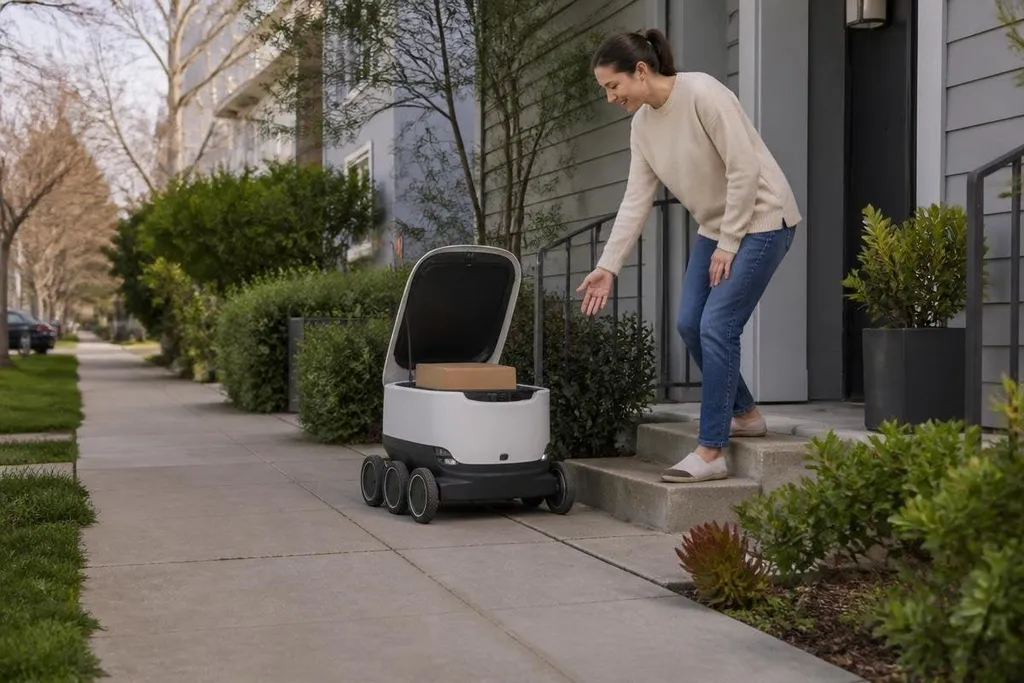
A last-mile robot carries a parcel from a local hub, store, or van to the customer’s door. That short trip is where delivery work meets curbs, crossings, stairs, weather, and people, so the robot’s value depends on how it handles those details.
Quick read:
- Small electric vehicles carry parcels along sidewalks.
- Cameras, LiDAR, maps, and remote support guide the trip.
- Stairs, bad weather, theft, and access rules still limit the job.
Where the robot fits
On most routes, the robot works on the final part of a delivery route. A van or cargo bike brings parcels close to a neighborhood, then the robot covers the remaining distance without sending a full vehicle to each address.
That split can reduce the number of short vehicle trips, but only where a robot can reach the building entrance safely. A delivery that ends at a locked gate, a flight of stairs, or a road without a safe crossing still needs a person or another vehicle.
The parcel also sets a hard limit. A small robot can carry only the size and weight its storage box and motors allow. Groceries, medicine, and small online orders fit the job more easily than large cartons or several parcels for different homes.
How it moves without a driver
A delivery robot combines several systems rather than relying on one sensor. Cameras help identify people, vehicles, signs, and curbs. LiDAR sends out laser pulses to measure nearby objects.
Maps and satellite positioning help the robot track its route, while wheel sensors record how far it has moved. Its software compares those inputs as it travels.
If a person blocks the sidewalk, it can slow down or stop. If the route is blocked, the system may ask a remote operator to review the scene and choose the next safe action.
That human support matters because public paths change from one trip to the next. A parked vehicle, a temporary fence, or a crowded entrance can create a problem that a fixed map cannot predict. For each uncertain case, the robot still needs a safe rule: wait, turn back, or ask for help.
What changes for e-commerce
The main change is a new handoff point between warehouse transport and the front door. A local shop, parcel hub, or delivery depot can load orders into a robot and send them out in smaller batches.
For an online retailer, that can make delivery planning more flexible. The robot can serve nearby addresses without a driver staying with it for the whole trip, while a van handles longer routes and larger loads. The actual result depends on travel distance, loading time, battery charging, and how often a remote operator must step in.
Customers also need a clear handoff. A lockable compartment can open with a code from the delivery app, but the robot must still reach a place where the customer can safely collect the parcel. A building entrance may work in one neighborhood and fail in another.
A delivery robot’s route can end at the curb, but the parcel still needs a safe pickup point and a clear record of what happened. Reporting from Robot24 can put the route, handoff setup, test date, and result beside claims about street delivery.
The limits that decide a pilot
Sidewalk robots face rules that delivery vans already know well. Local authorities may control where the robot can travel, how fast it can move, and who is responsible after a collision. Access for wheelchair users and people walking with prams also needs to remain clear.
Weather adds another test. Rain can affect cameras, ice can reduce wheel grip, and heat can change battery performance. A robot that works on a dry, open path may need a different route during a storm.
Security is a separate problem. The storage box needs a lock, the software needs a way to stop a stolen robot, and the delivery process needs proof that the right person collected the parcel. A live remote link may help, but it also adds a network and staffing cost.
A practical check before buying
A retailer planning a pilot should ask for these details:
- Route limits: map the roads, crossings, ramps, gates, and building entrances the robot can handle.
- Parcel limits: record the box size, payload in kilograms, and number of orders per trip.
- Human support: count remote operators, response time, and the cases that require manual control.
- Weather rules: set the rain, ice, heat, and wind conditions that stop deliveries.
- Customer handoff: test the lock, delivery code, collection area, and failed-delivery process.
- Operating cost: include charging, staff, repairs, insurance, permits, and recovery after a blocked route.
I'd start with a small route that has clear sidewalks and repeat addresses, then measure completed deliveries rather than counting successful demonstrations.
The useful figure is the share of orders a robot completes without a human taking over. Until that number holds across weather, access problems, and busy sidewalks, last-mile robots remain a limited delivery tool rather than a full replacement for the van.